Standing Lower Ab Workout: What It Can and Can't Do
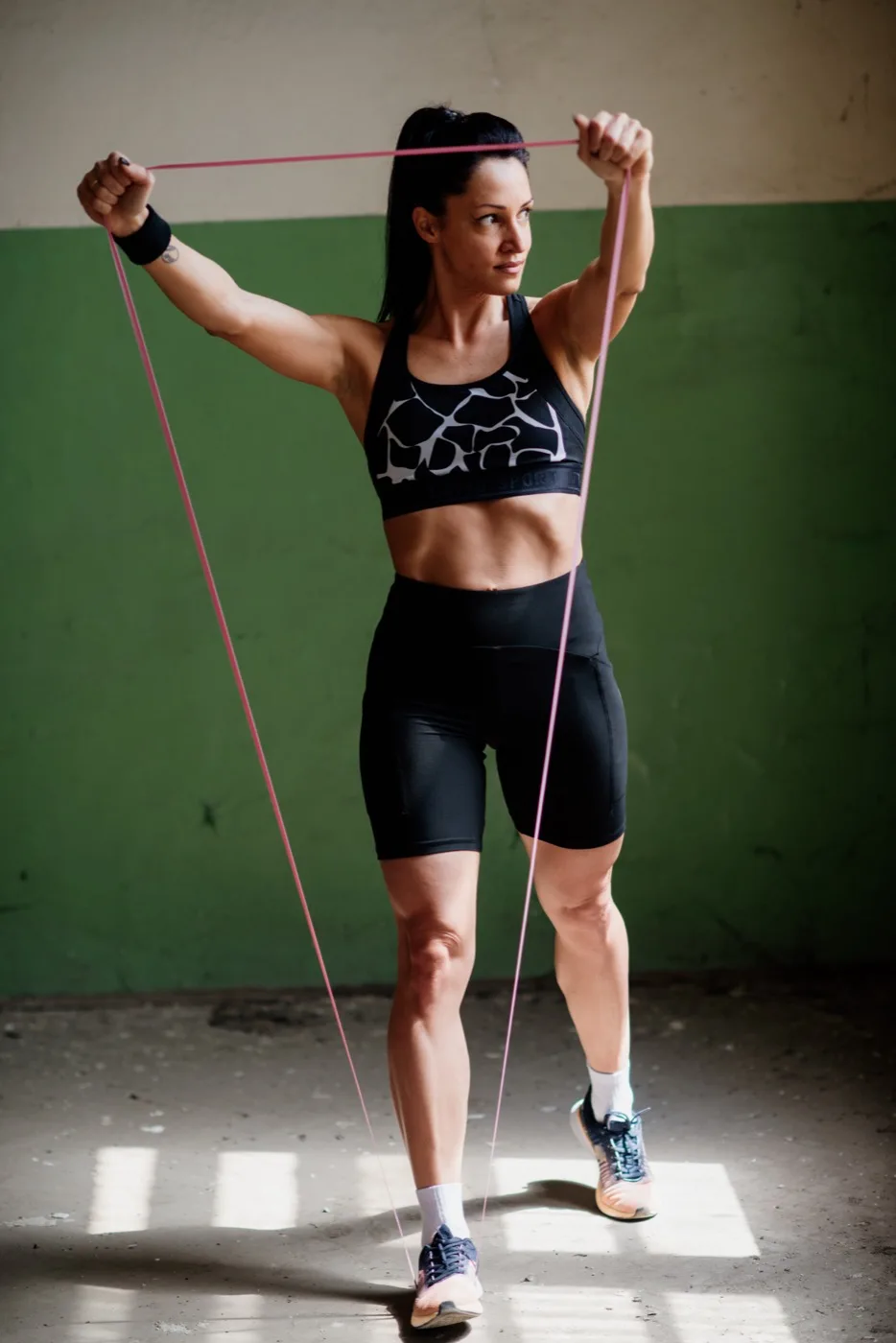
You can bias the lower portion of your abs while standing. You cannot isolate it, and no standing exercise removes fat from below your navel. That is the honest frame most standing-abs articles skip, and it changes what the session is for. Below: six standing moves with a pass/fail standard on each, what standing work is genuinely better at, and when to get on the floor instead.
The short answer
Standing ab work trains bracing — holding your midsection rigid while your limbs move and while gravity pulls you off balance. That is a real skill with real carryover, because you spend your day upright, not lying down.
What it is not is a superior way to load the abdominal muscles. Standing, your hips and lower back are free to help. On the floor, they are not. That constraint is exactly what makes floor work harder on the target.
So: standing work is not a shortcut. It is a different job with its own value, and a ceiling worth knowing about before you commit a training block to it.
Why “lower abs” is the wrong mental model
The rectus abdominis is a single sheet of muscle running from your ribs to your pubic bone, crossed by tendon bands that create the six-pack look. There is no separate lower muscle to train.
What is true is that recruitment is not uniform. EMG work comparing movements consistently finds the lower region works harder when the load comes from the legs moving toward the torso, rather than the torso moving toward the legs. A standing knee raise puts the load in the legs. That is why it biases lower — the same reason a reverse crunch does on the floor.
And the reason your lower row still is not visible is almost never the exercise selection. Fat below the navel is typically the last to go, and it goes when total body fat drops. Training the area does not accelerate that: Ramírez-Campillo and colleagues trained one leg for twelve weeks and found the fat that came off did not come off the trained limb preferentially. The body draws from where it wants to.
The session: six standing moves, with standards
Ten to twelve minutes, three to four times a week.
| # | Move | Dose | You passed if |
|---|---|---|---|
| 1 | Standing knee raise, slow | 10 per side | Knee rises from abdominal effort, no torso lean back, no swing |
| 2 | Standing oblique crunch | 12 per side | Ribs travel toward hip, hips stay square and still |
| 3 | Suitcase carry | 30 s per side | Shoulders level, no side lean, no gripping the ribs upward |
| 4 | Standing anti-rotation press | 10 per side | Hips and shoulders do not rotate at all under the band |
| 5 | Standing single-leg balance reach | 8 per side | No wobble at the standing hip, torso stays braced |
| 6 | Standing march with overhead hold | 45 s | Ribs stay down, lower back does not arch as arms go up |
Moves 3 and 4 are the ones that justify the format. A suitcase carry and an anti-rotation press load the midsection in a way no floor crunch does, because they ask you to resist a real external force while upright.
What standing work is genuinely better at
Anti-rotation and anti-lateral-flexion. Resisting a force trying to twist or bend you sideways is a standing skill. Carries and press-outs train it directly and have no good floor equivalent.
Carryover to everything else. Bracing under load while standing is what protects your back when you lift, carry, or sprint. Time spent here is not wasted even when it is not the most efficient way to grow the muscle.
Availability. No floor space, no mat, downstairs neighbours, a knee that will not tolerate kneeling, a back that objects to lying flat, later stages of pregnancy — standing work is often the version that actually gets done. A session you do beats a better session you skip.
When the floor beats standing
If your goal is thickness in the rectus abdominis — the part that makes definition sharp once you get lean — floor work under tension is more direct. Hollow body holds, reverse crunches and slow leg lowering remove the hips from the equation and put the load where you want it. Five minutes of floor work with a standard on each move is the shortest useful version.
The practical answer for most people is both: floor work for direct loading, standing work for bracing. If you have to pick one and your only constraint is preference, pick the floor. If your constraint is a bad back, a small room or a hard floor, pick standing without guilt — the frequency logic is identical either way.
The two mistakes that cancel a standing session
Leaning back on the knee raise. The moment your torso tips backward to meet the knee, the movement becomes a hip flexor exercise with an ab-shaped name. Stand tall, ribs down, let the knee come to you.
Swinging the oblique crunch. Momentum makes the rep feel productive and removes the tension that produces the adaptation. Slow enough that you could stop halfway is the test.
Both mistakes come from chasing rep counts. Both disappear when you hold yourself to the standards in the table — or when you hand the count to something that does not negotiate: Absly’s camera-counted challenge rejects a rep whose range is short or whose tempo is too fast to control.
How to know it is working
Two markers, neither of them the mirror.
A carry time. Suitcase carry at a fixed weight, timed, both sides. If the weaker side closes the gap over four weeks, your anti-lateral-flexion strength improved. That is a hard number the mirror cannot give you.
A repeatable score. Definition tells you whether the muscle is building. Leanness tells you whether the layer over it is thinning. Standing work should move the first and leave the second alone — and if you can see that separation, you know exactly which lever to pull next.
Train standing. Measure the same way every time.
Absly scores your core from one phone photo: 50 percent definition, 20 percent symmetry, 30 percent leanness. Scan before a four-week standing block and after it, in the same light at the same hour, and the two numbers are directly comparable.
Get Absly on the App Store iOS today, Android in progress.
Standing ab work deserves a place in the week. It just does not deserve the claim printed on most of the articles selling it — that it targets the lower abs and burns the fat sitting over them. It trains bracing, it biases the lower portion, and the fat is a separate problem with a separate solution. Knowing which is which is what matters. If you want the number that tells you where you stand today, start with what body fat percentage you need to see abs.
Image credit — Standing band work: Shixart1985, CC BY 2.0, via Wikimedia Commons.
Frequently asked
Do standing ab exercises work?
Yes, for bracing strength and anti-rotation control, which transfer to almost everything you do upright. They are weaker than floor work for direct abdominal loading, because standing lets your hips and spine share the effort. Use them as the main session only if the floor is unavailable.
Can standing exercises target your lower abs?
You can bias the lower portion, not isolate it. The rectus abdominis is one sheet, and EMG work shows the lower region is recruited more when the legs drive the movement. Standing knee raises do that. No exercise removes fat from below the navel.
Are standing ab workouts better than crunches?
Better for carryover to standing life, worse for loading the abs directly. A crunch takes the hips out of the equation; a standing move rarely does. Most people are best served by both — floor work for tension, standing work for bracing under load.
How long should a standing ab workout be?
Ten to twelve minutes, three to four times a week. Standing moves are lower in direct abdominal tension, so they tolerate slightly more volume than floor work, but the same rule applies: past twenty minutes it stops being ab training and becomes cardio.
Sources
- Regional activation of the rectus abdominis — EMG comparisons of upper and lower portion recruitment (PubMed)
- Vispute SS et al. (2011). The effect of abdominal exercise on abdominal fat. J Strength Cond Res 25(9).
- Ramírez-Campillo R et al. (2013). Regional fat changes induced by localized muscle endurance resistance training. J Strength Cond Res 27(8).
- U.S. Department of Health and Human Services (2018). Physical Activity Guidelines for Americans, 2nd edition.
Keep reading
The 5-Minute Ab Workout
Five minutes is enough to train the muscle and not enough to reveal it. Here is the session, with a pass/fail standard on every move, and the honest ceiling.
Skinfold Calipers: How Wrong Is the Pinch Test?
Calipers are cheap and repeatable in trained hands. The error lives in the hand, not the tool — here is how big it is and how to stop it moving.
How Often Should You Train Abs? Not Every Day
Abs recover in 24-48 hours. Three to four short sessions a week beat daily crunches — and here's the variable that actually makes them visible.
Absly is a training and self-assessment app, not a medical device. Its estimates are not a diagnosis. Talk to a healthcare professional before changing your diet or training if you have any health condition.