A score, not a vibe
90 seconds of camera time becomes one number on a 0-100 scale. It is the same number whether you like it or not — a score that flattered you would be worthless.
AbMaxx scans your abs from a photo too, and wraps meal and step tracking around it. Absly is narrower and more exact about the one thing: a named Abs Score on a 0-100 scale, an 8-week programme rebuilt around every rescan, and a challenge mode where the camera judges every rep and puts your record on a global board.
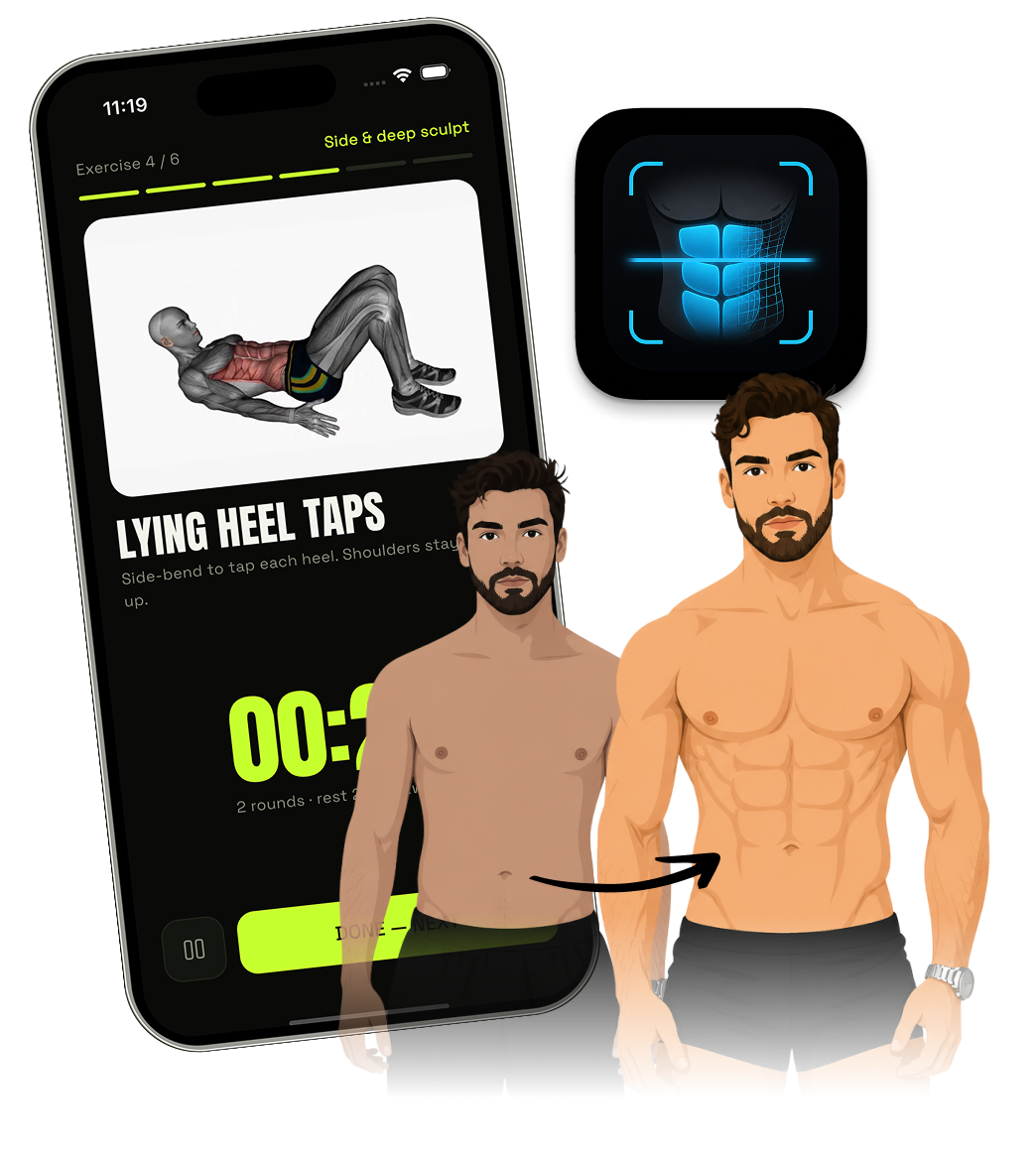
AbMaxx details taken from its App Store listing, checked on .
| Feature | Absly | AbMaxx |
|---|---|---|
| What it measures | Visible abdominal definition, from a photo | Abs analysis from a photo, across '1,000 core data points' |
| Output unit | Abs Score, 0-100 | — |
| Published formula | No, the scale is internal | — |
| Equipment required | A phone camera | A phone camera |
| Cost | Free to install; $3.99/week or $39.99/year | Free to install; $8.99/week, $11.99/month, $19.99-$49.99/year |
| Repeatability | Rescan whenever, always the same 0-100 scale | Rescan whenever |
| Longitudinal history | Score chart and photo timelapse | Visual charts and before-and-after comparisons |
| Availability | iOS | iOS |
| Stated programme length | 8 weeks, three phases | — |
| Plan rebuilt on later scans | ✓ | — |
| Rep counting through the camera | Yes, and invalid reps are rejected | ✓ |
| Leaderboard and duels | Top 100 per exercise, duels replay live | — |
| Shareable record card | ✓ | — |
| Nutrition, meals and steps | — | ✓ |
| Scanning other people | — | ✓ |
| App Store rating | Too new to show one | 4.7 from 642 ratings |
| App languages | 8 | 1 |
A dash means the feature is not mentioned on that app's public page. It is not proof it lacks it.
AbMaxx is the closest thing to Absly on the App Store, and it would be silly to pretend otherwise. You photograph your midsection, its AI analyses it — the listing claims a thousand “core data points” — and it builds you a routine aimed at whatever it decided is holding you back. It counts your reps through the camera. It draws charts and before-and-after comparisons, and puts milestones on top.
Around that it has built a wider app than ours: a nutrition tracker, meal suggestions, a step counter, an exercise library. It is free to install, at $8.99 a week, $11.99 a month, or a yearly plan the listing prices anywhere from $19.99 to $49.99 depending on which offer you land on. It also sells Guest Scans, so you can scan someone who is not you, two for $1.99.
It holds 4.7 stars from 642 ratings on the US App Store, and the version we checked had shipped the day before. It is a real product, actively worked on.
It gives the number a name and a scale. Absly returns an Abs Score from 0 to 100, and the same scan tomorrow is measured against the same scale — that is what makes a line on a chart mean anything. AbMaxx’s listing talks about analysis and about a thousand data points, but never states what number comes out or on what scale, so there is nothing on its public page to say what you would be tracking.
Eight weeks with a shape. Absly’s programme runs three phases across eight weeks: wake the core, build the grid, carve it out. You can see where you are in it. AbMaxx promises a tailored routine but its listing gives no length and no structure, so there is no way to know from the outside what finishing looks like.
It keeps re-reading you. Absly rebuilds the week around your most recent scan, so the plan answers to your body all the way through rather than only at sign-up.
Challenge mode, where the camera is the referee. Both apps count reps through the camera. Only one of them argues with you about it. Prop the phone up, pick a movement and a format — 60 seconds, or MAX until you stop for three seconds — and Apple’s on-device pose engine watches the set. Reps that fall short of full range, that go too fast to be controlled, or that drift out of frame are thrown out, and the result screen tells you how many and why: the camera rejected 4 reps — incomplete range. You finish with a validated count and a form figure, not a number you talked yourself into.
Then it leaves the room. Every run is ranked on a global top 100 for that exercise, over 30 days or all time, under a battle name you choose. You can pick anyone off that board and duel them: their run replays live alongside yours, rep for rep, and it ends in a victory, a defeat or a draw. And the record goes out as a share card — 42 hanging knee raises in 60 seconds, counted by the camera. Beat that.
AbMaxx has an AI Rep Counter, added in an April release. Its listing describes nothing around it: no board, no duels, no shared record.
Eight languages against one. English, French, Spanish, Portuguese, Polish, Japanese, Korean and Simplified Chinese. AbMaxx’s listing shows English only.
It is cheaper to try. $3.99 a week against $8.99.
It tracks what you eat, and we do not. This is the real one. Visible abs are mostly a question of body fat, and body fat is mostly a question of diet. AbMaxx has a nutrition tracker, meal suggestions and a step counter; Absly has none of them and assumes you handle that elsewhere. If you want one app for the whole problem, it is theirs, not ours.
Its cheapest year undercuts ours. $19.99 against our $39.99 — although its other yearly tiers reach $49.99, so which one you are shown matters.
It can scan other people. Guest Scans have no equivalent in Absly.
It has ratings and we do not yet. 642 of them, at 4.7. Absly is too new for the App Store to show a score at all, and there is no honest way to spin that.
Absly, if what you want is to know where your abs actually stand and to train against that number.
The difference is what each app hands back. AbMaxx analyses you and produces a routine. Absly produces a score — 0 to 100, the same scale every time — then builds eight structured weeks on top of it and rewrites them around every rescan. When you finish, you have two numbers and a timelapse, and the question “did that work?” has an answer instead of an impression.
And there is a reason to open it on the days you are not training. Challenge mode turns a set into a contest with a referee: the camera counts, rejects the reps you cut short, ranks the run on a global board, and hands you a card worth posting. Someone will beat it, and you will go again.
Take AbMaxx instead if you want your meals and your steps in the same app. That is a genuine gap on our side and no comparison table closes it.
Neither is a measurement of your health, and neither is a body-fat test. Both estimate what a camera can see, which is the surface — no phone can see visceral fat, and neither app is a medical device. Both also ask you to photograph your own body, so read both privacy policies and check what happens to those photos before you commit to either. In Absly they stay in your private account, are never shown to other users, and can be erased along with the account in one tap. And if you are making decisions about your weight or your eating, that is a conversation for a doctor or a registered dietitian, not for an app.
90 seconds of camera time becomes one number on a 0-100 scale. It is the same number whether you like it or not — a score that flattered you would be worthless.
Three phases — wake the core, build the grid, carve it out. No equipment, no gym, the surface of a mat. The plan rewrites itself each week around your latest scan.
The mirror flatters on a good day and lies on a bad one. Rescanning gives you a trend line instead of an impression, and the trend is what carves your core.
One photo after each workout, day one to today, in one swipe. Kept in your private account — never shown to other users, never sent to advertisers.