Skinfold Calipers: How Wrong Is the Pinch Test?
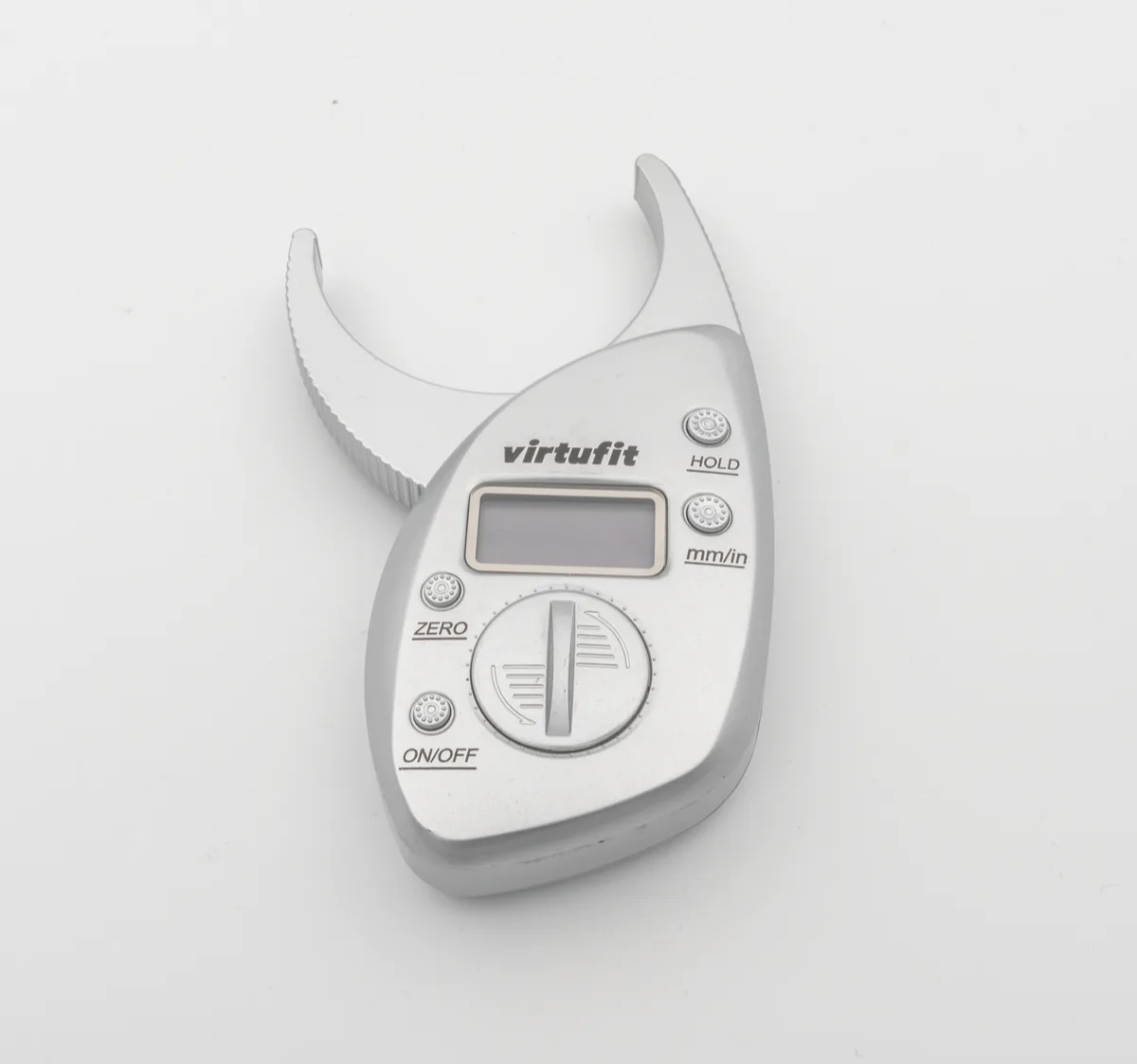
A skinfold caliper measures one thing well: the thickness of a pinch of skin and the fat under it. Everything after that — the conversion to a body fat percentage — is a prediction equation, and it carries an error of roughly 3 to 4 percentage points even when the pinch is taken correctly. The good news is that the error is mostly systematic. Repeat the same sites, the same way, with the same caliper, and the direction it shows you is trustworthy even when the absolute number is not.
What a caliper actually measures
You pinch a fold of skin, the jaws close on it at a set pressure, and you read millimetres. That is the measurement. It is direct, it is physical, and it does not care whether you drank coffee an hour ago — which already puts it ahead of an impedance scale.
The percentage comes later. You feed your millimetre readings into a regression equation — usually Jackson and Pollock, published in 1978 and 1980 — which predicts body density from skinfold sums, then converts density to a fat percentage. Two layers of prediction sit between your pinch and the number you write down.
That is not a reason to dismiss the tool. It is a reason to know which part of the number to trust.
How big is the error, honestly
Three separate errors stack up, and they are not the same size.
| Source of error | Rough size | Can you control it? |
|---|---|---|
| The prediction equation | ±3 to 4 percentage points against lab methods | No — it is baked in |
| Your technique (site, pinch, timing) | Several millimetres per site, easily | Yes, and this is the big one |
| The caliper model | Readings differ between brands | Yes — never switch caliper |
The equation error you inherit and cannot fix. The technique error is the one that ruins most home measurements, and it is entirely yours to solve. A 2023 review in the NIH library compared caliper models directly and found that instruments differ in the force their jaws apply to the fold — a Lange, a Harpenden and a Slim Guide do not give you the same millimetres on the same fold. So a reading from one brand cannot be compared to a reading from another.
Translation: your absolute body fat percentage from a caliper is a decent estimate with a real margin. Your change over eight weeks, measured with the same caliper by the same hand at the same sites, is a good signal.
The sites, and why the choice matters less than you think
The standard three-site protocol for men uses chest, abdomen and thigh. For women it uses triceps, suprailiac and thigh. Seven-site protocols add subscapular, midaxillary and others and are marginally more stable, mostly because averaging over more sites dilutes any single bad pinch.
Which protocol you pick barely matters. What matters is that you never change it. Switching from three sites to seven halfway through a programme makes your two readings incomparable, and you will read the jump as a body change when it was a method change.
How to take a reading that means something
- Same side, always. Convention is the right side of the body. Pick one and never swap.
- Same time. Morning, before eating, before training. Skinfolds are less volatile than impedance readings, but a hard session still leaves fluid in the tissue.
- Pinch a centimetre above the site. You are lifting the fold, then placing the jaws below your fingers, not clamping over them.
- Wait two seconds, then read. The fold compresses under the jaws. Reading instantly gives you a high number; waiting ten seconds gives you a low one. Two seconds, every time.
- Three readings per site, take the median. Not the average — the median throws out the one bad pinch instead of blending it in.
- Write down the millimetres, not just the percentage. The raw sum is the real data. The percentage is a derived guess and the equations change.
Steps 4 and 5 are what separate a caliper user whose numbers mean something from one whose numbers wander four points a week.
The problem nobody mentions: you cannot pinch your own back
Every three-site protocol for men includes the chest, which is awkward on yourself, and every seven-site protocol includes the subscapular site, which is behind your own shoulder blade. Self-measurement quietly drops or fudges the sites you cannot reach, and the ones you can reach get pinched at a slightly different spot every time because you are working by feel.
This is the practical ceiling of the home caliper. It is a good tool operated by a trained second person, and a mediocre one operated on yourself in a bathroom.
Calipers versus the alternatives
| Method | Cost | What moves it wrongly | Best for |
|---|---|---|---|
| Skinfold caliper | £10-200, once | Technique, unreachable sites, brand switch | Tracking fat change over months, ideally with a partner |
| Impedance scale | £30-100, once | Hydration, food, time of day, foot moisture | Weekly direction only, always at the same hour |
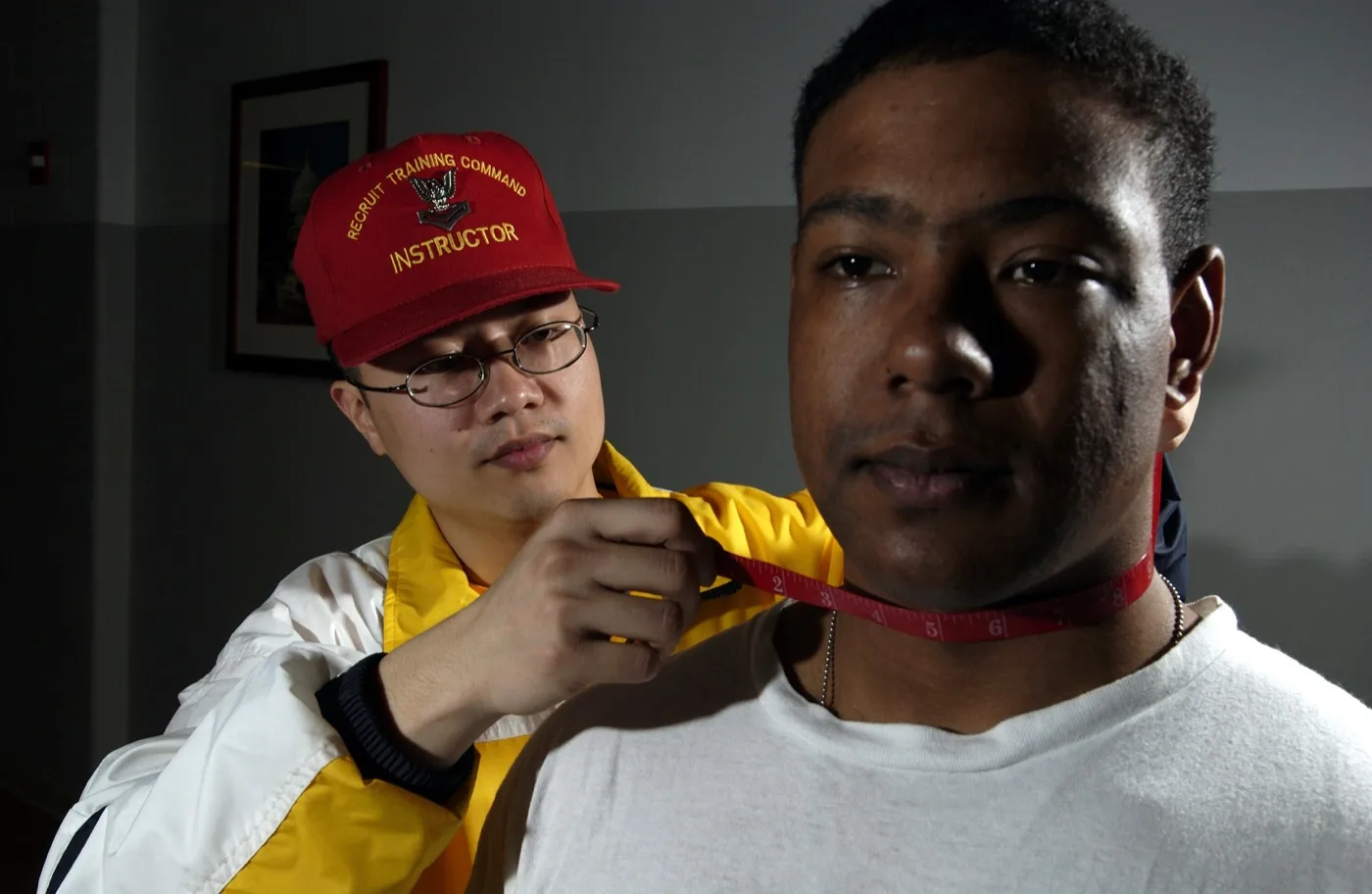
| Tape measurements | Almost nothing | Tape tension, landmark drift | Blunt, reliable trend at the waist |
| DEXA scan | £70-150 per scan | Very little, which is the point | A twice-yearly reference point |
| Phone scan | App | Light, pose, distance — unless the app fixes them | Frequent repeatable readings between DEXA scans |
Every row is an estimate except DEXA, and DEXA is the one you will not do often enough to catch a plateau.
Whichever row you pick, the number you are checking it against is the visibility threshold: 10 to 12 percent body fat for men, 16 to 20 for women, with the top two rows arriving a few points earlier.
What to do instead of chasing a percentage
Here is the uncomfortable summary: no home method gives you a body fat percentage you should quote to two decimal places. Calipers included. What every good method gives you is a repeatable reading, and repeatability is the property that actually tells you whether the last eight weeks worked.
So optimise for that. Fix your sites, your caliper, your hour and your protocol, and read the trend rather than the number. If you would rather not pinch yourself in a bathroom three times per site, the same logic applies to any method that controls its own inputs — a 90-second phone scan asks for the same light and the same distance every time, and for nobody’s help reaching your own back.
One photo, one number, same method every time.
Absly scores your core from a phone photo in 90 seconds and publishes its formula: 50 percent definition, 20 percent symmetry, 30 percent leanness. It does not output a body fat percentage — deliberately, because a camera cannot honestly produce one. What it gives you is a reading you can repeat next week and compare directly.
Get Absly on the App Store iOS today, Android in progress.
If you already own calipers and someone to hold them, keep using them. Just log the millimetres, keep the protocol frozen, and stop re-reading the percentage as though it were a fact about your body. It is an estimate with a margin, and the margin is bigger than most of the changes you are trying to detect.
Image credits — Caliper: PantheraLeo1359531, CC BY 4.0. Tape measurement: U.S. Navy, public domain. Both via Wikimedia Commons.
Frequently asked
How accurate is a skinfold caliper?
In trained hands, a caliper estimate typically lands within 3 to 4 percentage points of a laboratory method. In untrained hands the spread is wider, because most of the error comes from finding the site and pinching consistently, not from the tool. Repeat readings beat single ones.
Do cheap skinfold calipers work?
For tracking change, usually yes. A plastic caliper repeated the same way each month shows direction reliably. For an absolute number, jaw pressure differs between models, so readings from two brands are not interchangeable. Pick one caliper and never switch mid-programme.
Where do you measure skinfolds for body fat?
The common three-site protocol for men uses chest, abdomen and thigh; for women, triceps, suprailiac and thigh. Seven-site protocols add more. The sites matter less than doing the same ones, on the same side, in the same order, every single time.
Are calipers better than body fat scales?
For tracking, generally yes. Impedance scales swing with hydration, food and time of day, while a caliper measures tissue thickness directly. Both are estimates, not measurements of fat. The caliper demands technique; the scale demands nothing and rewards you accordingly.
Sources
- Cintra-Andrade JH et al. (2023). Skinfold calipers: which instrument to use? — PMC / NIH
- MRC Epidemiology Unit — Measurement Toolkit: skinfold measurement, protocol and sources of error
- Jackson AS & Pollock ML (1978); Jackson, Pollock & Ward (1980) — generalized equations for predicting body density
- American College of Sports Medicine — body composition assessment standards
Keep reading
The 5-Minute Ab Workout
Five minutes is enough to train the muscle and not enough to reveal it. Here is the session, with a pass/fail standard on every move, and the honest ceiling.
How Often Should You Train Abs? Not Every Day
Abs recover in 24-48 hours. Three to four short sessions a week beat daily crunches — and here's the variable that actually makes them visible.
Standing Lower Ab Workout: What It Can and Can't Do
Standing ab work is real training with a real ceiling. Six moves with a pass/fail standard, and the honest answer on whether you can target the lower abs.
Absly is a training and self-assessment app, not a medical device. Its estimates are not a diagnosis. Talk to a healthcare professional before changing your diet or training if you have any health condition.